
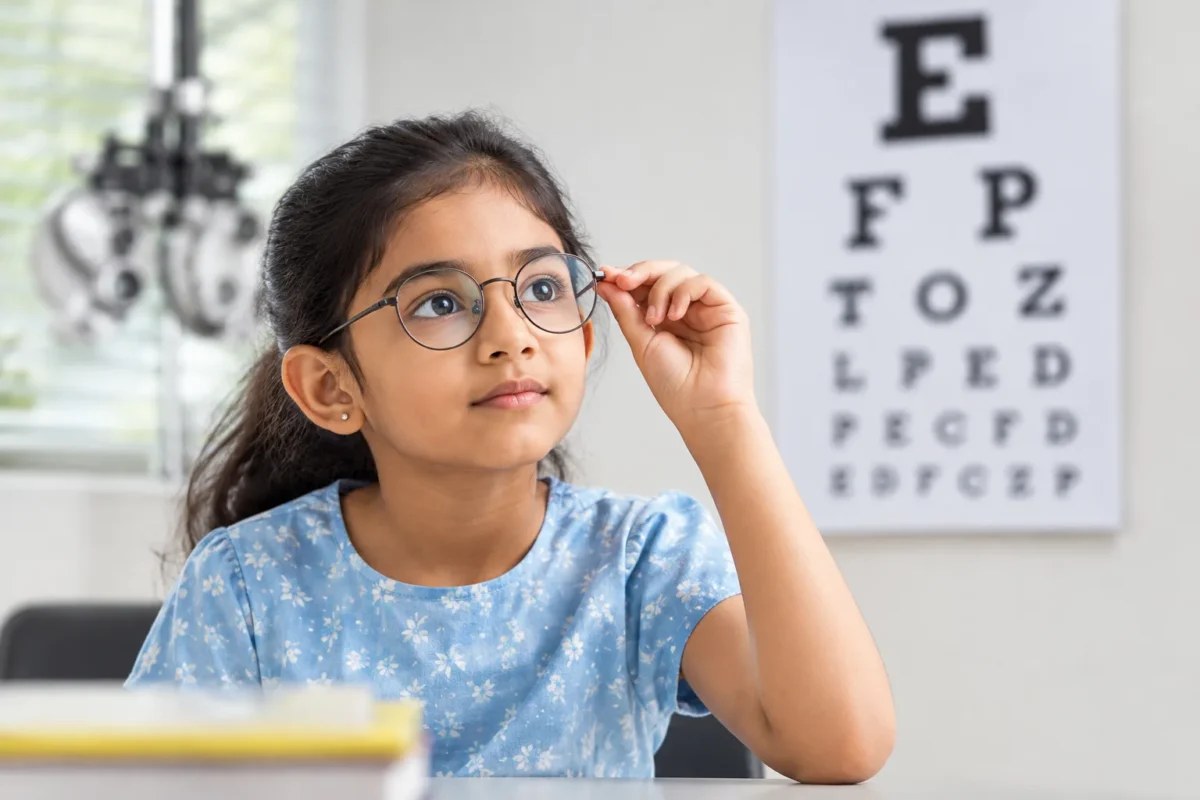
Can Children Develop Myopia? Early Signs Parents Should Watch For
November 18, 2026
Have Any Questions?
Please contact us, if you have any queries
Categories
Yes, children can develop myopia. It most often starts between the ages of 6 and 13, when the eyes are still growing. Myopia, also called short-sightedness or nearsightedness, makes distant objects look blurry while near objects stay clear. It usually shows up as squinting, sitting close to the TV, or trouble reading the board at school. Early detection helps slow its progress and protects your child’s long-term eye health.
Key Takeaways
- Children can develop myopia, usually during the school years.
- Myopia happens when the eye grows slightly too long, so distant objects focus in front of the retina.
- Common early signs are squinting, sitting close to screens, frequent eye rubbing and headaches.
- A family history of myopia, long hours of near work and little time outdoors raise the risk.
- Regular eye tests help us catch myopia early, before it gets worse.
- Myopia cannot be reversed, but its progression can often be slowed.
Table of Contents
- What Is Myopia in Children?
- Can Children Develop Myopia at Any Age?
- Why Does Myopia Develop in Children?
- Does Screen Time Cause Myopia?
- Early Signs of Myopia in Children Parents Should Watch For
- Signs Parents Can Notice at Home and at School
- When to Get Your Child’s Eyes Tested and How We Can Help
- FAQs
What Is Myopia in Children?
Myopia is a refractive error. The eye cannot focus distant light correctly on the retina, so faraway objects look blurred.
In children, myopia usually happens because the eyeball grows too long. A longer eye bends light to a point in front of the retina instead of on it.
Myopia in children is not the same as tired eyes. It does not go away with rest, and it often becomes stronger as the child grows.
Can Children Develop Myopia at Any Age?
Yes, but timing matters.
- Myopia can appear in young children, though it is more common after the age of 6.
- The earlier it starts, the more likely it is to progress.
- Power usually increases through the growing years and often slows in the late teens.
This is why childhood myopia needs regular monitoring and not just a one-time check.
Why Does Myopia Develop in Children?
There is rarely a single cause. Eye specialists usually see a mix of factors:
- Genetics: Children with one or both short-sighted parents are more likely to develop myopia.
- Close-up activities: Long hours of reading, studying and using phones or tablets add to the strain on growing eyes.
- Less time outdoors: Spending too little time in natural daylight is linked to a higher risk of myopia.
- Early onset: The younger a child starts, the faster the power can rise.
Does Screen Time Cause Myopia?
Screens alone are not proven to cause myopia, but they play a part. Long hours of near work, combined with fewer hours outdoors, are linked to a higher risk of myopia in children.
Simple habits help:
- Take a break every 20 minutes and look at something far away.
- Keep screens at a comfortable distance.
- Encourage outdoor play every day.
For more on how myopia develops, you can read the National Eye Institute’s overview on nearsightedness (myopia).
Early Signs of Myopia in Children Parents Should Watch For
Many children do not realise their vision is blurred. They assume everyone sees the same way, so they rarely complain. That is why parents need to watch for the signs.
Signs Parents Can Notice at Home and at School
What you may see:
- Squinting or narrowing the eyes to see far objects
- Sitting very close to the TV or holding books and phones near the face
- Frequent eye rubbing or blinking
- Tilting the head or covering one eye
- Losing interest in sports or outdoor games
- Dropping marks or struggling to copy from the board
What your child may say:
- “I can’t see the board clearly.”
- “My head hurts after school.”
- “My eyes feel tired.”
Not every child with myopia shows all of these signs. Even one or two are a good reason for an eye test.
When to Get Your Child’s Eyes Tested and How We Can Help
Book an eye test if your child shows any of the signs above, or if myopia runs in your family. Do not wait for a school screening to flag the problem.
At Dr. Rani Menon Maxivision Eye Hospitals, we have cared for patients across Kerala since 2008. If you are looking for an eye hospital in Thrissur for your child’s eye check-up, our doctors can assess your child’s vision with advanced diagnostic equipment. You can visit us at our branches in Thrissur, Guruvayur, Kunnamkulam, Angamaly and Wadakkancherry.
After the examination, our doctors will:
- Confirm whether your child has myopia and how strong it is
- Prescribe suitable glasses
- Discuss ways to slow down its progression, based on your child’s age and needs
- Suggest a follow-up schedule to track changes
FAQs
Yes. Myopia commonly begins in school-age children, usually between 6 and 13 years, and may increase until the late teens.
Squinting, sitting close to the TV, rubbing the eyes, headaches and difficulty seeing the board are the most common early signs.
Screen time is not the only cause. Genetics, long hours of near work and limited outdoor time all contribute.
No. Myopia cannot be reversed, but its progression can often be slowed with the right care, which is why early diagnosis matters.
No. Glasses correct blurred vision and do not weaken the eyes. Not wearing them can lead to strain and poor school performance.
Once a year is a good guide, or sooner if you notice any signs or myopia runs in the family.
High myopia can raise the risk of conditions such as retinal detachment later in life. Early care helps lower this risk.
Conclusion
Can children develop myopia? Yes, and it is more common than many parents expect. The signs are often subtle, so a child may struggle for months before anyone notices.
Watch for squinting, close viewing and complaints about the board. Encourage outdoor play, limit long hours of near work, and schedule regular eye tests.
If you notice any of these signs, book a child eye check-up at your nearest Dr. Rani Menon Maxivision Eye Hospitals branch. Early care makes a real difference to your child’s vision
This article is for general information and does not replace a medical examination. Please consult a qualified ophthalmologist about your eyes.